Martinmas Fair
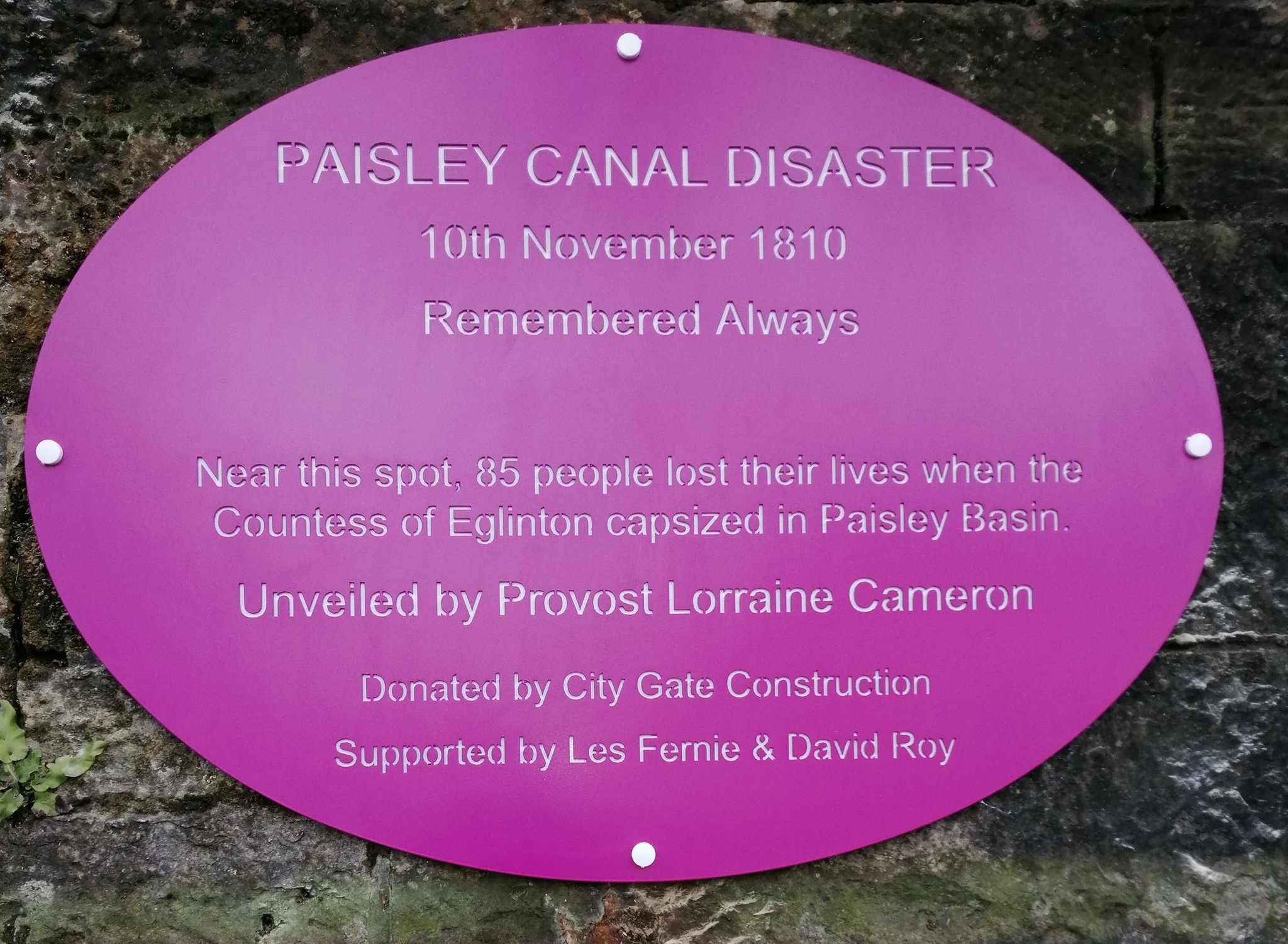
Saturday, 10th November 1810,
was to turn into a day of tragedy
like so many of the days that have
punctuated the history of Paisley
The launch of the first passenger boat on the Paisley Canal caused great excitement in the town.
The boat, The Countess of Eglinton, was designed to carry 150 passengers. It was drawn by two horses at a speed of four miles an hour.
Launched on 31st October, 1810, the boat began plying the canal between Paisley and Johnstone on 6th November.
When the Countess of Eglinton touched the landing stage, the eager Paisley folk rushed to board the boat as the passengers from Johnstone disembarked.
The boatmen, realising the danger of capsizing, quickly pushed the boat a few feet out from the bank.
Hoping to balance the boat, they shouted to the passengers to go into the cabin below.
But, amid the noise and confusion, their warnings went unheeded.
Eager passengers crowded the deck before the cabins and steerage below were filled.
In seconds the boat capsized and two hundred people, men, women and children were thrown into the cold, winter water. A contemporary account describes the scene as heart-rending.
Hats, bonnets, cloaks and shawls floated all over the surface of the canal basin. Many people helplessly drowned in the crush of fallen bodies.
Although the canal basin was said to be around 8 feet deep and about the size of a large fishpond, it had steep sides and very few could swim.
When the boat righted,a small number of passengers were clinging to her side, but some, chilled by cold of the severe November weather, lost hold, fell back and were drowned.
Others were pulled down by those struggling in the water. Men shouted for help and women screamed.
Soon, a cry went up in the town centre that the canal boat had capsized and her passengers drowned.
Everyone ran to the basin to see if friends or relatives were victims.
The water was being dragged with poles and hooks in a vain search for survivors.
People grasped the garments of the drowned as they rose to the surface and sudden screams would be heard as the living recognised the dead.
One old woman in a red cloak with “anxious face and hurried step” made her way to the scene. As two men passed her, she realised they were carrying her dead daughter.
Victims presumed dead were taken to nearby houses and laid out, However, medical men managed to revive twenty of them by “rubbing” the bodies.
Many Paisley homes lost two, three or, in some cases, four relatives.
The disaster had claimed 85 lives. 115 were providentially saved, with many being dragged to safety from the banks of the wharf.
Only ten people managed to swim out of the freezing cold waters of the canal basin.
The list made grim reading. Practically all the victims were weavers.
More than half the number were children, who at the period worked in the weaving trade.
Boys of nine or ten were listed as weavers or draw boys, while girls aged between twelve and fourteen were listed as clippers, darners or tambourers.
| Names: And Ages | |
| John Baird Age 11 | |
| William Parker Age 22 | |
| James Baillie Age 24 | |
| Catherine Wright Age 14 | |
| John Finlayson Age 63 | |
| William Smith Age 12 | |
| James Davatt Age 10 | |
| James Craig Age 13 | |
| Jas, Pinkerton Age 13 | |
| Matthew Morris Age 13 | |
| Duncan Keith Age 12 | |
| Jean Ronald Age 11 | |
| Agnes Ronald Age 9 Months | |
| Andrew Brown Age 13 | |
| John Fisher Age 12 | |
| John Shedden Age 14 | |
| Jean Colquhoun Age 14 | |
| Betty Ewing Age 5 | |
| Janet Thomson Age 14 | |
| Jean Whitehill Age 16 | |
| John Anderson Age 9 | |
| Alexandre Calder Age 12 | |
| James Campbell Age 9 | |
| Alexander Brown Age 14 | |
| Mary McKegg Age 21 | |
| James Lochhead Age 13 | |
| Jean Robertson Age 14 | |
| Barbara Mitchell Age 15 | |
| Archibald Combe Age 10 | |
| William Smith Age 11 | |
| Mitchel Houston Age 60 | |
| Margaret Turnbull Age 14 | |
| George Turnbull Age 10 | |
| Robert Stevenson Age 15 | |
| Joseph Wilson Age 12 | |
| William Hamilton Age 13 | |
| Peter Burgess Age 24 | |
| Janet Beith Age 22 | |
| Margret McGregor Age 10 | |
| William Beith Age 50 | |
| John Beith Age 11 | |
| Agnes Beith Age 9 | |
| John Tunks Age 20 | |
| Thomas Tudhope Age 16 | |
| James Gibb Age 16 | |
| David Kirkwood Age 18 | |
| Ann Niven Age 17 | |
| Mrs Peacock Age 50 | |
| Alan Peacock Age 11 | |
| William Peacock Age 6 | |
| Robert Watson Age 13 | |
| John Rowand Age 29 | |
| Agnes Rowand Age 6, months | |
| Elizabeth Downie Age 15 | |
| John McDonald Age 23 | |
| John Blair Age 5 | |
| Walter Carswell Age 12 | |
| Alexander Bigger Age 13 | |
| John McLachlan Age 14 | |
| Margret Craig Age 22 |
The magistrates decreed that a fund be set up to relieve the suffering of families bereft of any income. Shortly after the disaster, questions were asked in the town about the construction and design of the boat.
The manufacturers replied, “we shall only state what we believe to be contradicted. She is built on what was conceived the best model of those employed on other canals……. Is equal to any packet boat on the Forth-Clyde canal and in some respects superior.
To prevent tumbling, her keel acts as a ballast of a few tons, but it is not easy to comprehend how one should be constructed that shall not heel from the improper movements of an irregular crowd on the top”.
Despite the disaster the “Countess of Eglinton” continued to sail for many years on the canal. She carried countless passengers without further losses.
Paisley’s Silk handloom weaver, of Robert Tannahill. Robert was knwoen for his writing of poetry and Songs. his best knowen songs are. ..
“The Bonnie Wood o’ Craigielee”
(His tune was the inspiration for the song of “Waltzing Matilda”)
Also the song. ..”Thou Braes of Balquhidder”
(The tune for “Wild Mountain Thyme”).
On the 16th May 1810, Tannahill walked to Glasgow and called on his friend Alexander Borland, with whom he had a long conversation with Robert.
 The poet was so incoherent in what he said that Borland thought it prudent to see him safely home from Glasgow to his dwelling in Queen Street Paisley.,
On May, 17th, 1810, They hastened to their mother’s house, to find that Robert had returned to rest.
James and Mathew Tannahill, wished to remain overnight, as they were anxious as to Robert’s condition.
But their mother reassured and advised her sons to go back to their own homes and she would see to Robert herself, which they accordingly did.
During the night the mother had unconsciously dropped into sleep and was awakened by a slight noise of the family dog barking, and found Robert’s bed empty.
She at once sent for James and Mathew and also for Peter Burnet “Peter was a friend of the family.”
Instantly a search for Robert was formed.
Peter on saw a night watchman and when he asked if he had since anyone he was told that a small-sized man had been seen hurrying from Queen Street across George Street westward.
Peter made for the Brediland Road and soon found the poet’s coat and silver watch on the south side of the culvert of the Candren Burn.
Under the canal was the lifeless body of Robert.
His body was recovered and taken back to the house in Queen Street.
The Doctor was called for and pronounced Robert dead, Time of death:
was 2.00am: Saturday, 17th May, 1810
He was known to visit the “Irish Bothies were they lived” that built the Canal they brought with them new songs and poetry. .. Such as the songs
The Irish Farmer, Irish Teaching, and Peggy O’Raffetry. ..and many more
The old canal basin, the scene of Paisleys worst tragedy, was filled in around 1883.
It became a coal yard attached to Canal Street Railway Station.